

There are things in life we have every right to complain about.
People disappoint us. Plans fall apart. Life can be unfair. Circumstances happen that we never asked for and cannot control.
But then there are the other things.
The things we complain about over and over again while doing absolutely nothing to change them.
We complain about the job we hate but never look for another one.
We complain that our house is always cluttered but keep bringing more things into it.
We complain that we never have time for ourselves but continue saying yes to everyone.
We complain about being on our phones too much while picking them up every five minutes.
We complain about our weight and energy, but never change our habits.
We complain that we’ve lost touch with our friends but never send the text.
We complain about our finances but avoid looking at our bank account.
We complain about something for so long that the complaint itself becomes part of our routine.
And at some point, we have to ask ourselves a difficult question:
Am I actually trying to solve this problem—or have I gotten comfortable talking about it?
That’s where the Midlife Complaint Reset begins.
The idea is simple:
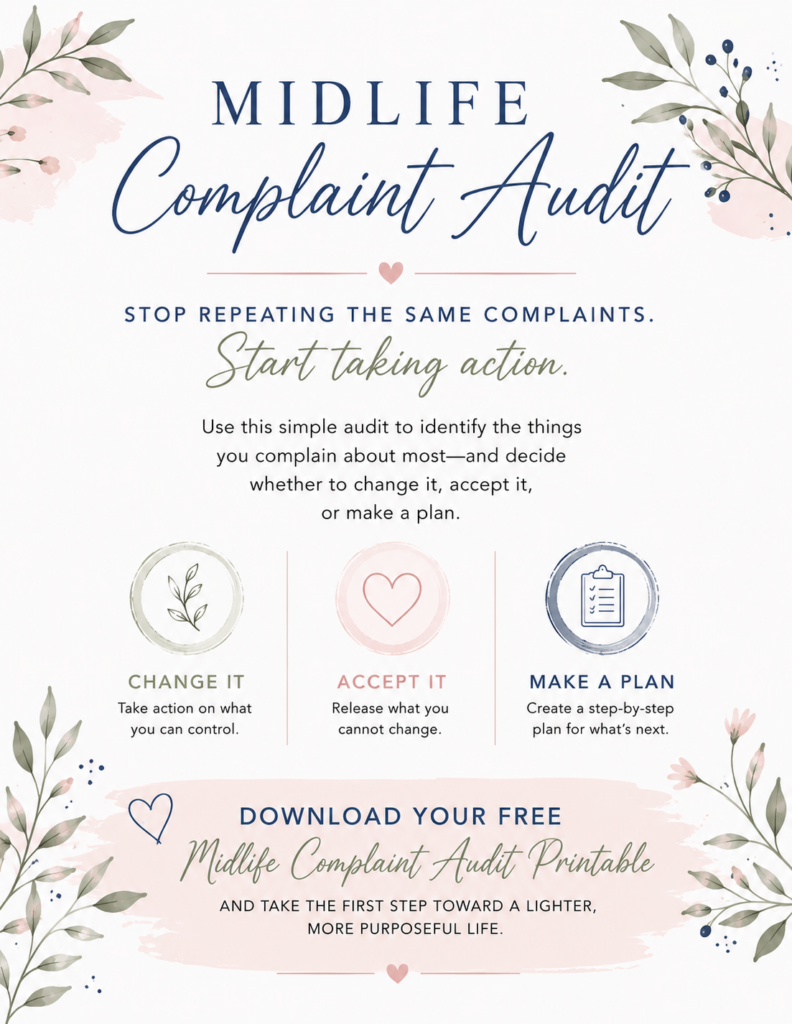
Change it. Accept it. Or make a plan.
Because while you can’t control everything that happens in your life, you don’t have to spend the next decade complaining about the things you can do something about.
Complaining Isn’t Always the Problem
Complaining gets a bad reputation.
We’re told to be positive. Be grateful. Look on the bright side.
But sometimes complaining serves a purpose.
It can help us recognize that something isn’t working.
“I’m exhausted from doing everything for everyone.”
“I don’t like the way I’m spending my days.”
“I feel lonely.”
“I hate my job.”
“I can’t stand how cluttered this house has become.”
Those thoughts aren’t necessarily negative.
They’re information.
They’re telling you there may be a gap between the life you’re currently living and the life you actually want.
The problem begins when the complaint becomes the final destination.
We identify the problem.
We talk about the problem.
We think about the problem.
We get frustrated about the problem.
Then we wake up tomorrow and do exactly the same thing.
Weeks become months.
Months become years.
And we’re still having the same conversation.
Complaining can tell you where something needs attention. But eventually, the complaint needs to lead somewhere.
Why Midlife Is a Good Time to Stop Having the Same Complaints
One of the interesting things about reaching midlife is realizing how quickly time actually passes.
Ten years doesn’t sound nearly as long as it once did.
You can look backward and remember things you were going to do “someday” that somehow still haven’t happened.
Maybe you’ve been saying for years that you want to change careers.
Maybe you’ve talked about simplifying your home.
Maybe you’ve wanted to repair a relationship.
Maybe you’ve dreamed about starting a business, learning something new, traveling, writing, creating, volunteering, or doing something completely different.
Maybe the change is much smaller.
You keep saying you need to stop overcommitting.
You want to spend less time scrolling.
You wish you had a hobby.
You want to stop letting someone’s opinion bother you.
You want to make new friends.
You want to get your finances organized.
You want your weekends to stop disappearing into errands and obligations.
And there’s always a perfectly reasonable reason to put it off.
Next month.
When things calm down.
After the holidays.
When the kids are older.
When you have more money.
When you have more time.
When you feel more motivated.
But eventually you realize something:
Life doesn’t usually clear the calendar and announce that it’s finally a convenient time to change.
Sometimes you simply have to decide that you don’t want to spend another year complaining about the same thing.
The Midlife Complaint Reset
The next time you notice yourself repeatedly complaining about something, stop and ask:
Can I change this?
If the answer is yes, change something.
Can I not change this?
Then work toward accepting it.
Can I change it eventually, but not right now?
Make a plan.
Those three options won’t solve every problem overnight.
But they can stop you from living indefinitely in the frustrating space between “I hate this” and “I’m not doing anything about it.”
Option 1: Change It
Sometimes we make change much bigger than it needs to be.
If we can’t completely solve the problem, we assume there’s no point doing anything.
But changing something doesn’t necessarily mean blowing up your entire life.
You don’t have to quit your job tomorrow.
You can update your résumé.
You don’t have to organize your entire house this weekend.
You can clean one drawer.
You don’t have to completely reinvent your social life.
You can text one person.
You don’t have to become a completely different person with perfect boundaries.
You can say no to one thing you don’t actually want to do.
You don’t have to delete every social media account.
You can start leaving your phone in another room for an hour.
The question isn’t always:
“How do I completely fix this?”
Sometimes the better question is:
“What is one thing I could do that would make this situation 10% better?”
That’s much easier to answer.
And once you start taking action, something changes psychologically.
You’re no longer simply stuck inside the problem.
You’re participating in the solution.
Option 2: Accept It
This may be the hardest option.
Because there are some things we genuinely cannot change.
We cannot change the past.
We cannot control other people’s personalities.
We cannot force someone to apologize.
We cannot make our children make the choices we would make for them.
We cannot prevent every disappointment.
We cannot stop time.
We cannot go back and make different decisions at 25, 30, or 35.
And yet we can spend an enormous amount of emotional energy arguing with realities that aren’t going anywhere.
Acceptance doesn’t mean saying:
“This is wonderful.”
It doesn’t mean pretending something didn’t hurt.
It doesn’t mean allowing someone to mistreat you.
And it doesn’t mean you don’t wish things were different.
Acceptance simply means recognizing:
This is the reality I’m working with.
There’s tremendous freedom in that.
Instead of asking:
“Why can’t this be different?”
you can begin asking:
“Given that this is true, how do I want to live now?”
Maybe someone isn’t going to become the person you wish they were.
Maybe a season of your life ended before you were ready.
Maybe something you dreamed about didn’t happen.
Maybe you made a decision years ago that you wouldn’t make today.
You can continue reopening the argument with reality.
Or you can decide that reality no longer gets to consume so much of your energy.
Some things need changing.
Other things need releasing.
Knowing the difference can change the way you experience your life.
Option 3: Make a Plan
There’s also a third category that doesn’t get talked about enough.
Things you can change—but not immediately.
Maybe you desperately want another job, but your family depends on your income.
Maybe you want to move, but financially it isn’t possible yet.
Maybe you want a new career, but you need additional education or training.
Maybe you want to start a business, but you can’t devote 40 hours a week to it.
Maybe you’re unhappy with your finances, but getting out of debt will take several years.
These situations can make us feel trapped because the solution isn’t available today.
But there’s a huge difference between:
“I’m stuck here.”
and
“I’m working my way out of here.”
That’s what a plan does.
A plan creates movement before your circumstances actually change.
Instead of:
“I hate my job.”
It becomes:
“For the next six months, I’m going to save money, update my résumé, learn a new skill, and apply for two positions every week.”
Instead of:
“We’ll never be able to move.”
It becomes:
“We need $15,000 before moving makes sense. We’re going to create a savings plan and revisit this in one year.”
Instead of:
“I wish I had done something with this idea.”
It becomes:
“I’m giving myself three hours every Saturday morning to work on it.”
Your life may look exactly the same tomorrow.
But mentally, everything has changed.
You’re no longer waiting. You’re building.
Try a Complaint Audit
Here’s a simple exercise that can reveal a lot.
Think about the things you’ve complained about during the last few weeks.
Not the random annoyances.
The recurring ones.
The complaints your spouse, best friend, sister, or coworker has probably heard more than once.
Write them down.
Then put each complaint into one of three categories:
CHANGE IT
ACCEPT IT
MAKE A PLAN
For each one, decide what your next step is.
For example:
| Complaint | My Choice | My Next Step |
|---|---|---|
| My house is always cluttered. | Change it. | Fill one donation bag this weekend. |
| My children are growing up. | Accept it. | Stop wishing for the old season and be present in this one. |
| I hate my job. | Make a plan. | Research three realistic career options. |
| I never have time for myself. | Change it. | Protect one hour on Saturday morning. |
| I wish we could move. | Make a plan. | Figure out exactly what we’d need financially. |
| I regret something I did years ago. | Accept it. | Take the lesson and stop trying to rewrite the past. |
You don’t have to tackle everything.
Choose one.
Especially if there’s one complaint you’ve been repeating for years.
You can download a complaint audit worksheet here!
What Have You Been Complaining About for More Than a Year?
This question might be uncomfortable.
But it’s worth asking.
What are you still complaining about today that you were also complaining about a year ago?
Maybe even five years ago?
Don’t judge yourself for it.
Get curious about it.
Why hasn’t it changed?
Is it truly outside your control?
Are you afraid of what changing it would require?
Are you waiting for someone else to change first?
Are you overwhelmed because the solution feels too big?
Have you convinced yourself you don’t have any options?
Or have you simply never stopped long enough to make a decision?
Sometimes the biggest shift doesn’t come from finally solving the problem.
It comes from deciding that you’re no longer willing to remain passive about it.
Watch Out for the Complaint Loop
There’s another reason repeated complaining can keep us stuck.
Complaining gives us a tiny sense of release.
We vent.
Someone agrees with us.
We feel understood.
And for a moment, we feel better.
But feeling better about the problem isn’t the same thing as solving the problem.
Then the situation happens again.
We get frustrated again.
We complain again.
We get temporary relief again.
Nothing changes.
That’s the complaint loop.
The goal isn’t to never vent.
We’re human. Sometimes we need to say, “This is awful,” and have someone say, “Yep. It really is.”
But after you’ve vented, ask yourself:
Now what?
Those two words can interrupt the entire cycle.
Stop Waiting for Someone Else to Fix It
Sometimes our complaint depends on someone else.
“I wish my husband would…”
“If my boss would just…”
“My friend never…”
“My kids always…”
“If people would stop…”
And maybe you’re right.
Maybe someone else should change.
But there’s a problem with building your happiness around that expectation:
You don’t control whether they do.
You only control what you do next.
You can have the conversation.
You can ask for what you need.
You can set a boundary.
You can change your expectations.
You can change your participation.
You can change how much access something gets to your time and energy.
Sometimes your power isn’t in changing another person.
It’s in deciding what you are going to do if nothing changes.
You Don’t Need to Reinvent Your Whole Life
A midlife reset doesn’t have to mean waking up tomorrow and becoming an entirely different woman.
In fact, most lasting changes probably won’t happen that way.
They happen through smaller decisions.
One conversation.
One boundary.
One application.
One hour protected on your calendar.
One phone call.
One bag donated.
One savings account opened.
One class researched.
One invitation sent.
One decision finally made.
Those little actions don’t look dramatic.
But neither does turning a ship a few degrees.
At first, the difference seems tiny.
Eventually, you end up somewhere completely different.
Don’t Spend the Next Decade Having the Same Conversation With Yourself
There are plenty of things in life that deserve patience.
And plenty that require acceptance.
But there are also things we’ve been postponing simply because changing them is uncomfortable.
Midlife can be a good time to stop postponing.
Not because you’re running out of time.
Because you’ve lived long enough to understand how valuable your time actually is.
You don’t have to spend another decade saying:
“Someday.”
“I wish.”
“I hate that.”
“I really need to…”
“I’ve been meaning to…”
You can decide.
Change it.
If it’s within your control, take one small action.
Accept it.
If it truly cannot be changed, stop asking reality to be different before you allow yourself to move forward.
Make a plan.
If change will take time, figure out what needs to happen between where you are and where you want to be.
And then start.
Your Midlife Renewal Project doesn’t have to begin with a dramatic transformation.
It might begin with something much simpler.
Closing Thoughts
What complaints keep showing up in your life?
Take a few minutes to do your own Midlife Complaint Audit. Write down the things you find yourself complaining about most, decide whether you need to change it, accept it, or make a plan, and choose your next step.
I’ve created a free printable to make it easy.
Download the Midlife Complaint Audit Printable
You may be surprised by how much lighter life feels when you stop repeating the same complaint and start deciding what to do with it..